The New Digital Ecosystem: Why the 2026 Decision is More Complex
In the early days of smartphones, simply having an app was a competitive differentiator. Today, the digital ecosystem is heavily saturated, and consumer expectations are at an all-time high. A successful app must offer undeniable value that a standard web browser cannot provide. Recently, Fatcow Digital proudly participated in a global survey by TechBehemoths alongside 2,300+ IT firms to uncover exactly how businesses are approaching this choice today.Evolving User Behavior: The Demand for Speed and Personalization
Modern consumers have zero tolerance for friction. If a digital experience takes more than a few seconds to load, users will abandon it. In 2026, users demand hyper-personalized experiences tailored to their exact preferences, location, and past behavior. Apps excel in this area by tapping directly into native device data to curate bespoke user journeys.The Impact of 5G, AI, and AR Integration on Mobile Experiences
The widespread adoption of 5G networks has eliminated many of the traditional bandwidth constraints, allowing for heavier, more complex mobile applications. Artificial Intelligence (AI) is no longer a buzzword; it is a baseline expectation for predictive search and automated customer support. Furthermore, Augmented Reality (AR) is reshaping retail and real estate. If your business model relies on leveraging these cutting-edge integrations, a native mobile app is often the only viable platform.Mobile App vs. Mobile Website vs. PWA: A 2026 Feature Breakdown
Before committing to a native app build, it is crucial to understand the alternatives. The lines between web and app technologies continue to blur, making the strategic choice more nuanced than ever.| Feature | Native Mobile App | Mobile Website | Progressive Web App (PWA) |
|---|---|---|---|
| Performance Speed | Lightning fast; optimized for specific OS | Moderate; dependent on browser & network | Fast; leverages advanced caching |
| Offline Capabilities | High; can function without internet | None; requires active connection | Moderate; works offline with cached data |
| Time-to-Market | Slow (3-9 months) | Fast (1-3 months) | Fast to Moderate (2-4 months) |
| Development Cost | High ($30k – $150k+) | Low to Moderate ($5k – $25k) | Moderate ($15k – $40k) |
| Discoverability | App Stores (High friction to download) | Search Engines (SEO) | Search Engines (Installable via browser) |
Performance, Speed, and Offline Functionality Superiority
Native mobile apps are built specifically for iOS or Android, allowing them to fully utilize device hardware. This results in superior performance, fluid animations, and the critical ability to function perfectly even when the user is offline.Development Cost and Time-to-Market Comparison
Building a high-quality app requires a substantial upfront budget and a longer development cycle. Conversely, a professional web design and development project for a mobile-optimized site is significantly cheaper to launch and update, offering an immediate time-to-market.Accessibility and Distribution: App Store Hurdles vs. Browser Reach
A mobile website is universally accessible to anyone with a browser. There is zero friction to entry. A mobile app requires a user to navigate to an App Store, download the file, and grant permissions—one of the highest hurdles in digital marketing today.Progressive Web Apps (PWAs): The Ideal Middle Ground
For businesses that want app-like features without the massive budget, PWAs are the ultimate 2026 compromise. Built with standard web technologies, they can be saved to a home screen, send push notifications, and operate offline, bypassing the App Store entirely.Clear Indicators Your Business Demands a Dedicated Mobile App
Not every company needs an app, but for those that do, it is a game-changer. Here are the precise scenarios where investing in a native application is the most strategic choice you can make.Achieving High Customer Engagement and Retention via Push Notifications
If your business relies on repeat purchases or daily engagement, an app provides a direct line to your customer’s pocket. Push notifications, when used strategically, boast opening rates exponentially higher than traditional email marketing, driving unparalleled customer retention.Necessity for Native Device Features (GPS, Camera, Biometrics)
Does your service require real-time location tracking, barcode scanning, or biometric security (FaceID/Fingerprint) for rapid logins? Mobile browsers have limitations accessing these hardware features. A native app integrates seamlessly with device hardware, making it essential for functional utility.Leveraging First-Party Data for Deep Personalization
In a cookieless world, first-party data is gold. Executing a data-driven marketing strategy is infinitely easier when mobile apps allow you to collect rich behavioral data based on how users interact within your ecosystem. This data powers deep personalization, allowing you to serve hyper-relevant content.Signs and Scenarios Where App Development is a Wasted Investment
Conversely, building an app just to “have an app” is a fast track to burned capital. Watch out for these red flags before you greenlight a development project.Budget Constraints and the High Cost of Ongoing Maintenance
If your budget barely covers the initial build, stop immediately. A mobile app is not a “set it and forget it” product. Server costs, third-party API fees, security patches, and OS update compatibilities mean that long-term maintenance will cost 15% to 20% of your initial development budget annually.Low Frequency of Customer Interaction and Use
If your customers only buy from you once a year, they will not waste precious storage space on their phones for your app. A robust web presence backed by strong local SEO strategies will serve this customer base much better.The High Barrier to App Download and User Adoption
Convincing a user to download an app requires aggressive marketing and undeniable incentives. If you do not have a marketing budget specifically dedicated to user acquisition and adoption (such as Google App Campaigns), your app will languish unseen in the App Store.Analyzing the True Cost and ROI of Mobile Apps
To make a solid business case for a mobile app in 2026, you must look beyond the initial invoice and project the long-term financial impact.
Calculating Initial Development vs. Long-Term Operational Expenses
Initial development is only the tip of the iceberg. True Total Cost of Ownership (TCO) includes continuous updates, marketing for user acquisition, backend server hosting, and customer support. Decision-makers must map out a 3-to-5 year financial plan.Measuring Value: Increased Sales, Operational Efficiency, and CLV
App ROI isn’t just about direct sales. It is measured in operational efficiency and Customer Lifetime Value (CLV). App users are generally a brand’s most loyal demographic; increasing their CLV through an app can offset high acquisition costs.Addressing Critical Overlooked Strategic Challenges
Beyond code and design, modern app development introduces complex business challenges that are frequently overlooked during the planning phase.Navigating App Store Compliance and Data Privacy
In 2026, global data protection laws (GDPR, CCPA) are stricter than ever. Your app must have airtight data collection policies. Furthermore, Apple and Google have stringent App Store verification, payment processing rules, and privacy manifest requirements.Operational Strategy: Choosing Between In-House vs. Outsourced Maintenance
Who fixes the app when an iOS update breaks it? Hiring a full-time, in-house mobile development team offers total control but comes with high salary costs. Outsourcing to an agency provides specialized talent and flexibility, but requires tight SLAs to ensure rapid response times.Environmental and Digital Sustainability (ESG)
Corporate ESG (Environmental, Social, and Governance) goals now extend to digital products. Native apps require vast server infrastructure for data syncing, frequent heavy downloads for updates, and continuous background processing, all of which contribute to a higher carbon footprint.Final Decision Framework for 2026 Success
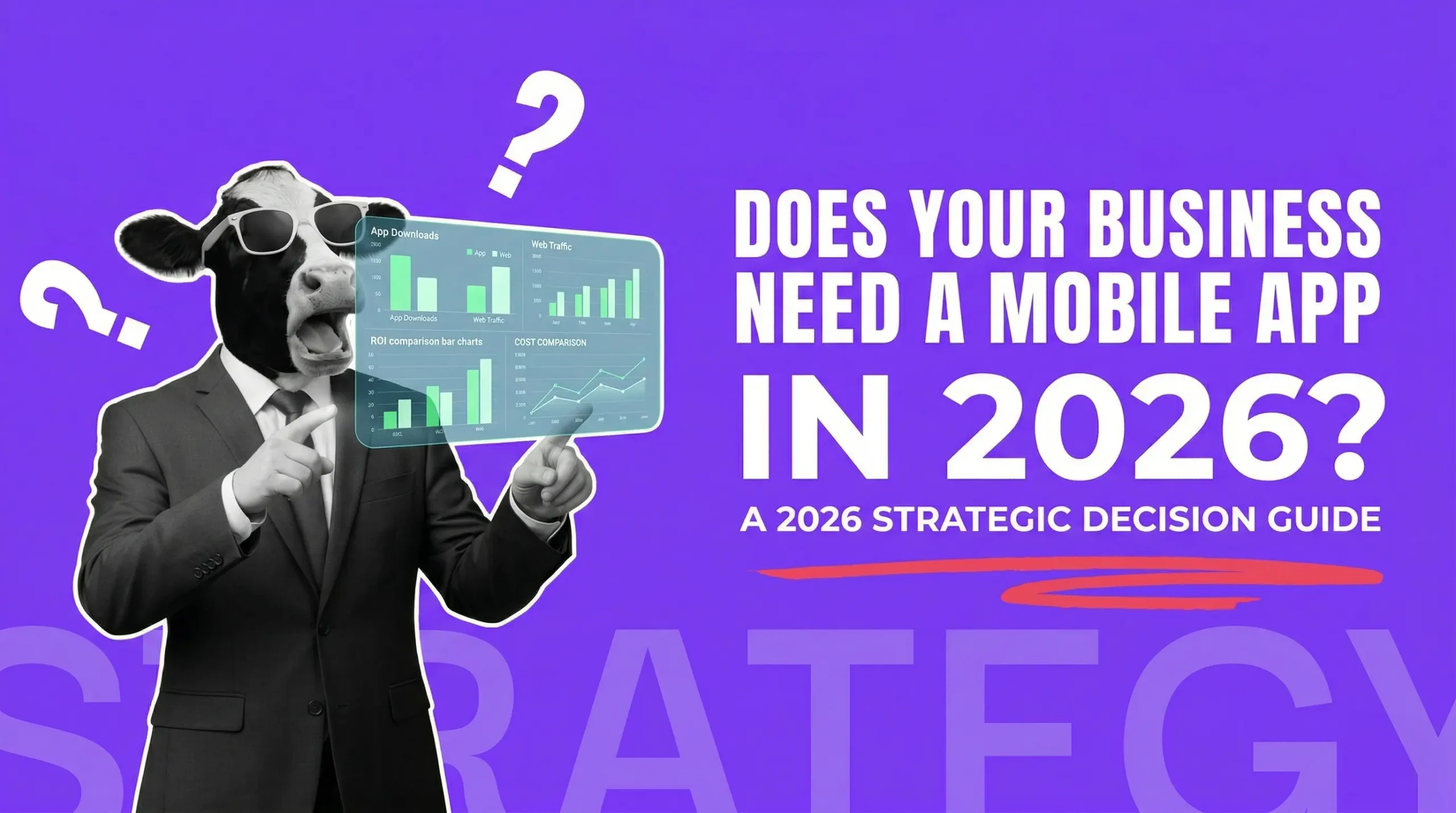
Deciding to build a mobile app in 2026 is a commitment to a new digital product lifecycle. If your business thrives on daily engagement, requires deep hardware integration, and possesses the budget for aggressive ongoing maintenance, a native app will yield massive ROI. If your interactions are infrequent, or your budget is tight, an optimized Mobile Website or PWA is the superior strategic choice. To dive deeper into the raw data shaping these trends, we highly encourage you to read the full Does Your Business Need a Mobile App in 2026? survey results published by TechBehemoths. Need help determining the best digital path forward? Book a free consultation with Fatcow Digital today, and let’s assess your 2026 technology strategy.Frequently Asked Questions (FAQs)
Is a mobile app still essential for small businesses in 2026?
Not every small business needs an app; the decision depends on whether the business requires high-frequency customer interaction, deep personalization, or use of native device features like GPS and push notifications. A well-optimized mobile website or a Progressive Web App (PWA) might be sufficient for low-frequency interactions.What is the main difference between a mobile app and a mobile website in terms of user experience?
Mobile apps offer faster performance, often work offline, and allow for deeper personalization, creating a smoother, more reliable user experience. Mobile websites are instantly accessible across any browser or device without installation, reducing the barrier to entry for casual users.How much does it cost to build and maintain a custom mobile app?
Initial custom app development can cost tens of thousands of dollars, ranging significantly based on complexity. However, the high cost of long-term maintenance, which includes fixing bugs, ensuring compatibility with new OS updates, and meeting app store compliance, is often a more significant ongoing expense.What key technology trends are shaping mobile apps in 2026?
Key trends include leveraging AI and machine learning for hyper-personalization, integrating AR/VR for immersive user experiences, optimizing for 5G connectivity, and increased adoption of cross-platform development frameworks.How do mobile apps improve customer retention and loyalty?
Apps are powerful retention tools because they enable cost-effective direct communication via personalized push notifications and in-app messaging, simplify loyalty and reward programs, and keep the brand constantly visible on the user’s screen.What is a Progressive Web App (PWA), and is it a good alternative to a native app?
PWAs are websites built using modern standards that offer app-like capabilities, such as offline functionality and home screen installation, directly through a browser. They are often ideal for businesses seeking rapid deployment, wider reach, and a lower development budget than native apps.When should a business prioritize a mobile app over a standard mobile website?
A business should prioritize an app if its core offering involves repeat engagement, requires real-time tracking (e.g., logistics), needs secure, one-click transactions (e.g., fintech), or if device-specific features are critical to the service.